T J Blaines
T J Blaines
Praise
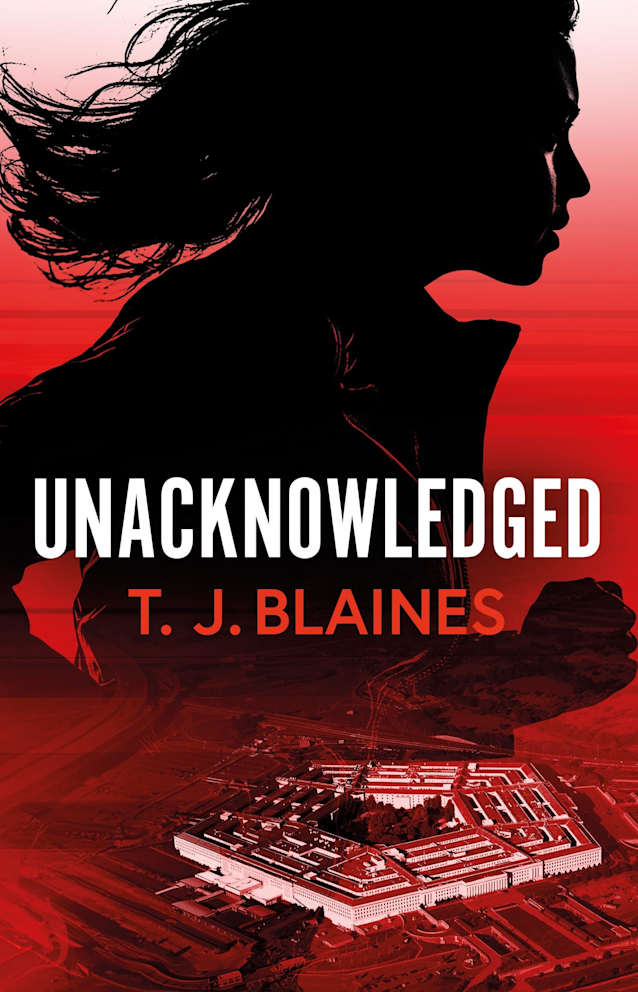
J Blaines’ Unacknowledged is a debut thriller that immediately announces itself with ambition, with a strong female protagonist and delivering no shortage of adrenaline-charged moments. On the surface, it is a high-tech military thriller packed with acronyms, weapons systems, and covert operations. But beneath the thrilling scenes classified programs lies a surprisingly personal story about grief and the cost of knowledge.
Blaines also raises bigger questions that linger after the final chapter. What happens when surveillance tools become too powerful to control? Who truly holds power in a system of “unacknowledged” programs hidden from oversight? The novel explores these questions while being fun to read throughout and full of exciting scenes. For fans of Tom Clancy’s action or Michael Crichton’s speculative science, Unacknowledged will be a perfect escape. Overall, Unacknowledged is a bold, uniquely imagined debut that blends cutting-edge technology with heartfelt character work.
J Blaines’ Unacknowledged opens with a tightly executed weapons test that sets the tone for a novel built on precision, control, and consequence. Rather than relying on spectacle, the scene establishes a clear focus on modern military capability, where speed, timing, and technical innovation define the outcome.
The story is driven by Callie Faulkner, whose presence dominates the narrative from beginning to end. As a senior engineer working within a covert naval development unit, Callie leads teams responsible for moving experimental weapons into operational use. Her authority is demonstrated through action—briefings, decisions under pressure, and her ability to manage both the technical demands of her role and the institutional forces surrounding it.
The world around her is shaped by a small number of consistently recurring figures. Jason Otto Springer provides continuity within NEWT, acting as both a professional anchor and a link to the organisation’s operational structure. Richard Bowman introduces friction, challenging the secrecy and direction of Callie’s work, and reflecting the competitive nature of defence research at the highest level. Running beneath the present-day narrative is the lasting presence of Cassie—Cassandra Ward—whose relationship with Callie forms the emotional core of the book. Though no longer alive, Cassie’s influence is continuous, shaping Callie’s outlook, decisions, and sense of purpose.
The novel unfolds across two connected strands. The first follows the development and testing of advanced weapons systems, including the pressures that come with classified work—restricted information, competing departments, and the need to deliver results under scrutiny. Blaines handles this aspect with clarity, allowing the technical detail to support the narrative without overwhelming it.
The second strand begins with the murder of her dog walker, pulling Callie out of her controlled world and into something far less predictable. What starts as an isolated incident soon begins to overlap with her work, placing her in situations where control slips and the consequences become harder to contain.
Callie is not presented as invulnerable. Her chronic physical condition is a constant factor, influencing how she operates and responds under pressure. This is reinforced by the emotional weight of her past, particularly her relationship with Cassie, which is revealed through memory rather than exposition. These elements give the character a grounded presence that avoids exaggeration.
Structurally, the novel moves from order to instability. Early chapters are defined by controlled environments—testing facilities, briefings, and clearly defined objectives. As events develop, that structure begins to erode. Information becomes less certain, motivations harder to read, and Callie is increasingly forced into a reactive position.
The supporting cast is used with restraint. Each character serves a clear function within the narrative, whether as authority, opposition, or influence. This keeps the story focused and avoids unnecessary diversion.
The conclusion resolves the immediate situation without overstating its impact. The systems Callie operates within remain intact, and the wider tensions introduced earlier in the novel are left in place, giving the ending a measured and credible finish.
Overall, Unacknowledged is a disciplined, technically grounded thriller that builds its impact through structure, controlled pacing, and sustained character pressure. It will appeal to readers who value clarity, realism, and a narrative that maintains focus from beginning to end.
It is highly recommended!
A juggernaut of a thriller that ramps up the action on page one and never lets up. Callie Faulkner is intellectually and physically intimidating, but she is not without flaws. As she gets sucked into a vortex of conspiracy with horrifying implications, will she overcome her limitations or will they be her downfall?
The book is written through the experience of the protagonist, and provides rich character background and development that simultaneously makes her more believable than 99% of most genre characters, while making the reader want to know even more about what makes this girl tick.
Set within the D.C. beltway world of defensive contracting, the story paints a stylized and intriguing picture of shadowy operators and off-the-books weapons projects that makes the Chesapeake Bay area seem like a place where danger is always present beneath the thinnest of veils.
Highly recommended.